What Does a Standard Urine Drug Test Check For? (2026 Guide)
If you are an HR manager setting up a workplace screening program or an applicant preparing for a pre-employment screen, you likely want to know exactly what does a standard urine drug test check for. A standard urine drug test checks for five to ten classes of drugs, depending on the specific panel ordered by the employer or clinic. The most common 5-panel test detects marijuana (THC), cocaine, amphetamines, opiates, and phencyclidine (PCP). Extended panels, such as the standard 10-panel, also check for prescription sedatives and painkillers like benzodiazepines, barbiturates, and methadone.
While the phrase "standard test" is used casually, in the clinical and toxicology laboratory world, it usually refers to the federal guidelines established by the Substance Abuse and Mental Health Services Administration (SAMHSA). These guidelines form the backbone of both federal workplace testing and private employer screening across the United States.
The Federal Standard: The 5-Panel Drug Test
When people refer to a standard drug test, they are most often talking about the 5-panel urine screen mandated for safety-sensitive transportation workers under Department of Transportation (DOT) regulation 49 CFR Part 40.
Historically, this test looked for five basic drug classes. However, as the opioid epidemic evolved, federal agencies updated the required testing panels to capture a broader range of heavily abused prescription medications. Today, the standard DOT and SAMHSA 5-panel test checks for:
- Marijuana (THC): Specifically, the test looks for THCA, the primary metabolite your body produces after consuming cannabis.
- Cocaine: The test detects benzoylecgonine, the primary metabolite of cocaine.
- Amphetamines and Methamphetamines: This category includes amphetamine, methamphetamine, and MDMA (Ecstasy/Molly).
- Opiates and Semi-Synthetic Opioids: Originally, this category only tested for naturally occurring opiates like codeine, morphine, and heroin (detected via the 6-AM metabolite). The panel was expanded to include semi-synthetic opioids, meaning it now strictly checks for hydrocodone, hydromorphone, oxycodone, and oxymorphone.
- Phencyclidine (PCP): A synthetic dissociative anesthetic.
Recent Update: The landscape of standard testing is always shifting. Effective July 2025, SAMHSA updated the Mandatory Guidelines for Federal Workplace Drug Testing Programs to officially add fentanyl to the authorized federal testing panel. While DOT must go through its own rulemaking process to adopt this for transportation workers, many private employers have already integrated fentanyl into their standard screens.
The Private Employer Standard: 10-Panel and 12-Panel Tests
If you operate a non-DOT workplace, you are not strictly bound by the federal 5-panel restrictions. State laws vary widely regarding workplace drug testing—especially concerning recreational marijuana—so employers must always consult local regulations. However, many private companies opt for a broader screen to mitigate workplace safety risks.
A standard 10-panel urine drug test includes everything in the 5-panel, plus five additional classes of prescription and illicit drugs:
- Benzodiazepines: Central nervous system depressants like alprazolam (Xanax) and diazepam (Valium).
- Barbiturates: Older, highly addictive sedatives like phenobarbital.
- Methadone: A synthetic opioid commonly used in addiction treatment and for chronic pain.
- Propoxyphene: A narcotic pain reliever (largely pulled from the US market but still tested in older standard panels).
- Methaqualone: A sedative-hypnotic drug (Quaaludes).
To keep up with modern substance abuse trends, healthcare facilities, staffing agencies, and safety-focused employers frequently upgrade to a 12-panel test. This adds highly relevant targets like buprenorphine (Suboxone) and fentanyl. At LabX Diagnostic Systems, we provide scalable bulk drug testing kits for employers and a confidential at-home 12-panel drug test for individuals seeking lab-accurate results in private.
Cut-Off Levels: When is a Test "Positive"?
A standard urine drug test does not just look for any microscopic trace of a drug. It measures the concentration of drug metabolites against strict, scientifically validated "cut-off levels" measured in nanograms per milliliter (ng/mL).
Cut-off levels serve a critical purpose: they prevent false positives from incidental exposure. For example, walking past someone smoking marijuana at a concert might introduce trace amounts of THC into your system, but it will not be enough to trigger a positive result at the federal cut-off level.
Here are the current SAMHSA and DOT cut-off levels for the standard 5-panel urine test:
| Drug Class | Initial Screening Cut-Off | Confirmatory Cut-Off |
|---|---|---|
| Marijuana (THCA) | 50 ng/mL | 15 ng/mL |
| Cocaine (Benzoylecgonine) | 150 ng/mL | 100 ng/mL |
| Amphetamines / Methamphetamines | 500 ng/mL | 250 ng/mL |
| MDMA / MDA | 500 ng/mL | 250 ng/mL |
| Opiates (Codeine / Morphine) | 2000 ng/mL | 2000 ng/mL |
| Semi-Synthetic Opioids (Hydrocodone) | 300 ng/mL | 100 ng/mL |
| PCP | 25 ng/mL | 25 ng/mL |
The Two-Step Laboratory Process
Understanding what a test checks for also requires understanding how it checks for it. A certified clinical laboratory uses a rigorous two-step process to ensure absolute accuracy.
1. Immunoassay Screening
The first step is the initial screen, which uses immunoassay technology. Antibodies in the test react to specific drug metabolites in the urine. If the concentration of a drug is below the initial cut-off level, the test is reported as negative. If the concentration meets or exceeds the cut-off, the sample is flagged as "non-negative." A non-negative is never the final word.
2. LC-MS/MS or GC/MS Confirmation
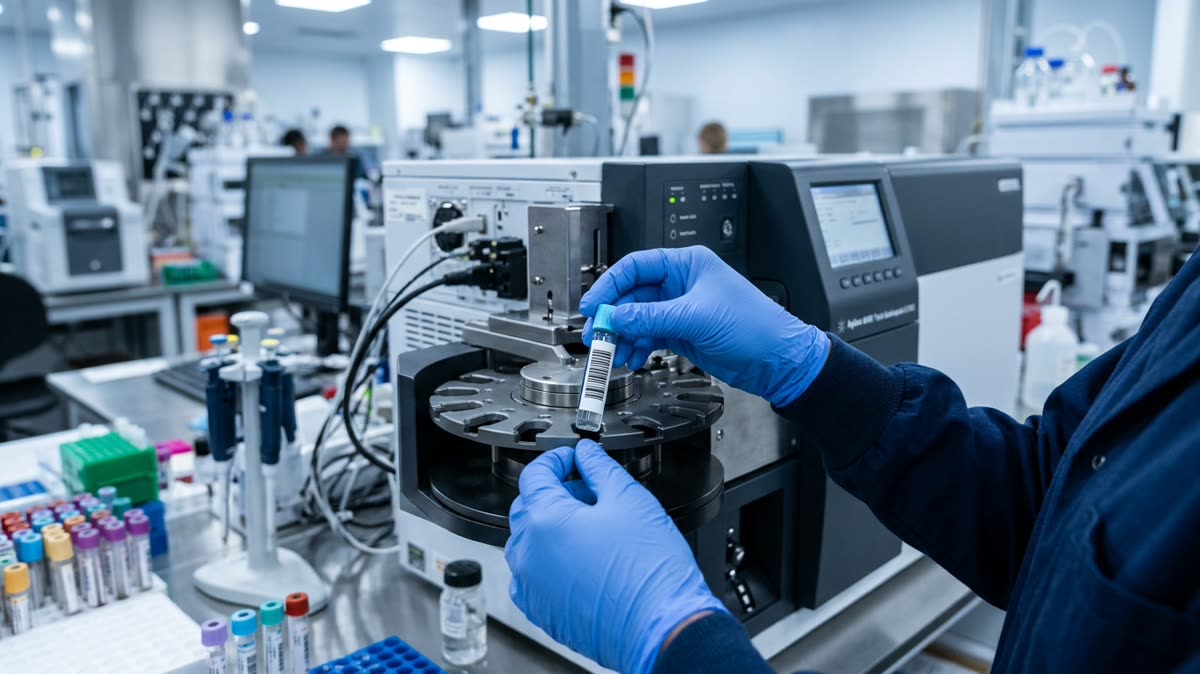
Every non-negative screen must undergo a confirmatory test using advanced laboratory technology, typically Liquid Chromatography-Tandem Mass Spectrometry (LC-MS/MS) or Gas Chromatography-Mass Spectrometry (GC/MS). This equipment breaks the molecules down and measures their exact mass and structure. It acts as a molecular fingerprint, effectively eliminating the risk of a false positive caused by cross-reacting over-the-counter medications (like pseudoephedrine triggering an amphetamine screen).
Specimen Validity Testing: Checking the Urine Itself
A standard urine drug test also checks the physical and chemical properties of the urine to ensure the sample is valid. Laboratories perform Specimen Validity Testing (SVT) to detect if a donor has attempted to dilute, substitute, or adulterate their sample.
The laboratory checks for:
- Creatinine: A natural waste product of muscle breakdown. If creatinine falls below 20 mg/dL, the sample is considered diluted. If it falls below 2 mg/dL, it is considered substituted (not human urine).
- Specific Gravity: This measures the density of the urine compared to water. Normal human urine falls within a specific range; outside of that range indicates heavy dilution or substitution.
- pH Levels: Normal urine has a pH between 4.5 and 9.0. If a sample is highly acidic or highly alkaline, it indicates an adulterant (like bleach or vinegar) was added.
- Oxidizing Adulterants: Labs actively screen for commercial adulterants containing glutaraldehyde, nitrites, or halogens designed to mask drug metabolites.
If a sample fails validity testing, the laboratory will report it as invalid, adulterated, or substituted, which is treated as a refusal to test under DOT regulations and most corporate policies.
The Role of the Medical Review Officer (MRO)
What happens if a standard urine drug test detects a prescription medication, like oxycodone prescribed after a surgery, or Adderall prescribed for ADHD?
This is where the Medical Review Officer (MRO) steps in. An MRO is a licensed physician with specialized training in substance abuse and drug testing. Before a laboratory reports a positive result to an employer, the MRO contacts the donor to conduct a private medical interview.
If the donor can provide a verifiable, legally valid prescription for the detected substance, and they are taking it at the prescribed dosage, the MRO will overturn the laboratory positive and report the final result to the employer as negative. This crucial step protects patient privacy and ensures employees are not penalized for legitimate medical treatments. (Note: This article provides education on laboratory processes, not medical advice. Always discuss your prescriptions and testing requirements with your doctor or a qualified MRO).
DOT vs. Non-DOT Testing
It is important to recognize the strict legal boundary between DOT and non-DOT testing. If an employee falls under DOT authority (such as a commercial truck driver, airline pilot, or transit worker), the employer must follow the rigid protocols of 49 CFR Part 40. This includes using the specific federal 5-panel, mandatory laboratory confirmation, MRO review, and utilizing the federal Custody and Control Form (CCF). For a deeper dive into these regulatory differences, read our DOT vs Non-DOT Drug Testing Employer Guide.
Non-DOT employers have much more flexibility. They can utilize 10-panel or 12-panel tests, utilize electronic CCFs, and adapt their policies to fit their specific industry risks. However, non-DOT employers must carefully navigate state laws. Many states have recently enacted legislation protecting employees who use recreational marijuana off-duty, which may restrict an employer's ability to take adverse action based solely on a positive THC urine test.
Summary for Employers and Individuals
So, what does a standard urine drug test check for? At a minimum, it screens for marijuana, cocaine, amphetamines, opiates, and PCP. For broader workplace safety, it often expands to include benzodiazepines, barbiturates, and synthetic opioids like methadone and fentanyl.
By combining immunoassay screening, highly specific mass spectrometry confirmation, and rigorous specimen validity testing, standard laboratory urine tests remain the gold standard for accuracy and reliability in toxicology.
Header image: AI-generated illustration.